In the final months Marines spent at Camp Leatherneck prior to their departure from Helmand province in late October, logistics officials took leaders from the Afghan National Army's 215th Corps on an eight-week walk-through of the base, signing over buildings and equipment to them as they went. But despite their careful efforts, the Marines had little idea of how the Afghan troops, much more poorly resourced than their foreign counterparts, planned to use the sprawling base after the American and British forces left.
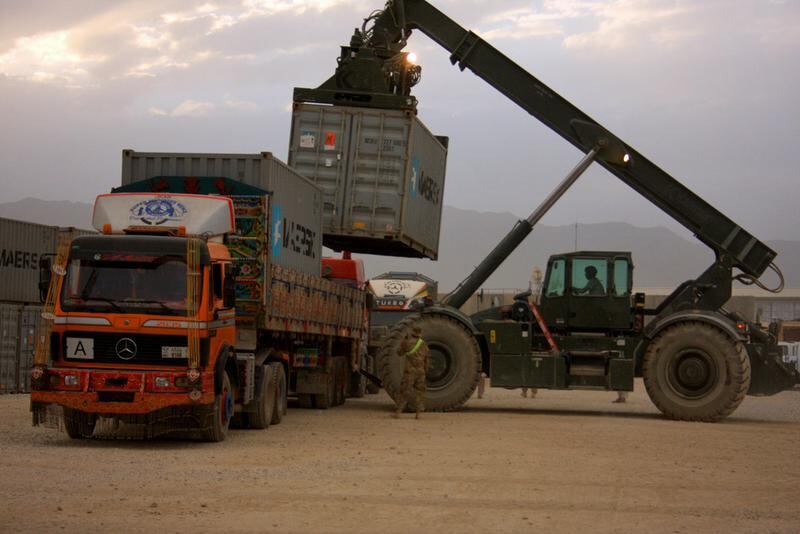
The comprehensive orientation covered inventory of the 298 buildings and assorted vehicles and non-military equipment that the Marines would leave behind for their use, some $260 million worth of gear in all, from airstrips to chairs and desks, said Col. Doug Patterson, senior logistics officer for Brig. Gen. Daniel Yoo, the commander of Regional Command Southwest. One by one, the Marines handed over all the keys to the structures that were still standing, he said.
Among the buildings the Afghan forces received was the complex primary dining facility, equipped with two dining rooms and enough space to feed thousands of troops at a sitting. They also got the keys to an unused 64,000-square foot military headquarters building that the Army paid nearly $36 million to build in 2010, despite claims from the Marine commander on the ground, then-Maj. Gen. Richard Mills, that he didn't need it. Handsomely outfitted and unused, the complex has been held up by agencies as the Special Inspector General For Afghanistan Reconstruction as a symbol for U.S. bureaucratic excess and waste in Afghanistan. While some of the furniture in this building was pulled out and transferred to U.S. Forces-Afghanistan for its use, Patterson said the Afghan forces received the structure intact.
From Kandahar Airfield, where the Marines regrouped following their departure from Leatherneck, Patterson could only guess at how 215th Corps leaders were going to employ this windfall of American buildings and gear.
One potential plan, he said, involved moving portions of 215th Corps headquarters at the adjacent Camp Shorabak, or the collocated 3rd Brigade headquarters, inside the Leatherneck perimeter. Another had Leatherneck designated as a military training center in addition to their Regional Corps Battle School at Shorabak.
Officials said the Afghan troops are making use of the Bastion Airfield next door to travel between Helmand and Kabul, and that may continue.
"They really weren't that forthcoming in terms of how they planned to utilize it," he said. "So that was one of the things that made it somewhat difficult for us," to reshape it for their use.
The eight-week tour also included a briefer on the wells aboard the base and a discussion of hiring contractors to keep the lights and power on in the tents and headquarters buildings. Again, Patterson said, the Afghans were noncommittal, and the prospect of maintaining the structures to U.S. standards seems unlikely. Due to the difficulty of hiring laborers in Helmand province, officials aboard Camp Leatherneck have long been forced to hire U.S. and foreign nationals through the Army's Logistics Civil Augmentation Program to work there.
Built to accommodate 26,000 troops, Leatherneck was far too large for the Afghan National Security Forces in Helmand. Over the last few months, Patterson said Marines have worked to build an inner perimeter to the base, dubbed the "Green Zone," that measured about eight miles compared to the original 17, and could house 10,000 troops.
But the most important question, whether the Afghan forces can provide adequate base security for Leatherneck-Bastion, even with a smaller perimeter to manage, remains an open one.
Lt. Col. Brad Weston, commander of Task Force Belleau Wood, which oversaw security for the complex until the Marines lifted off, said the Afghan troops had stepped up to the task of guarding their new property with vigor. While original plans had them manning fewer guard posts than the better-resourced and more technologically capable allied troops, the ANA had made a late decision to ramp up efforts.
"They made the conclusion that they were going to go ahead and man every post, in some places more so than what we did," he said. "It was impressive."
Yoo, the commander of RC-SW, said the question of how the Afghans can safely manage their new bases has long been a concern, driving American planning and decisions up to the final point of handoff.
"When we were leaving, we wanted to give them something that was safe, secure and most importantly sustainable," he said. "We didn't want to give them a millstone around their neck."