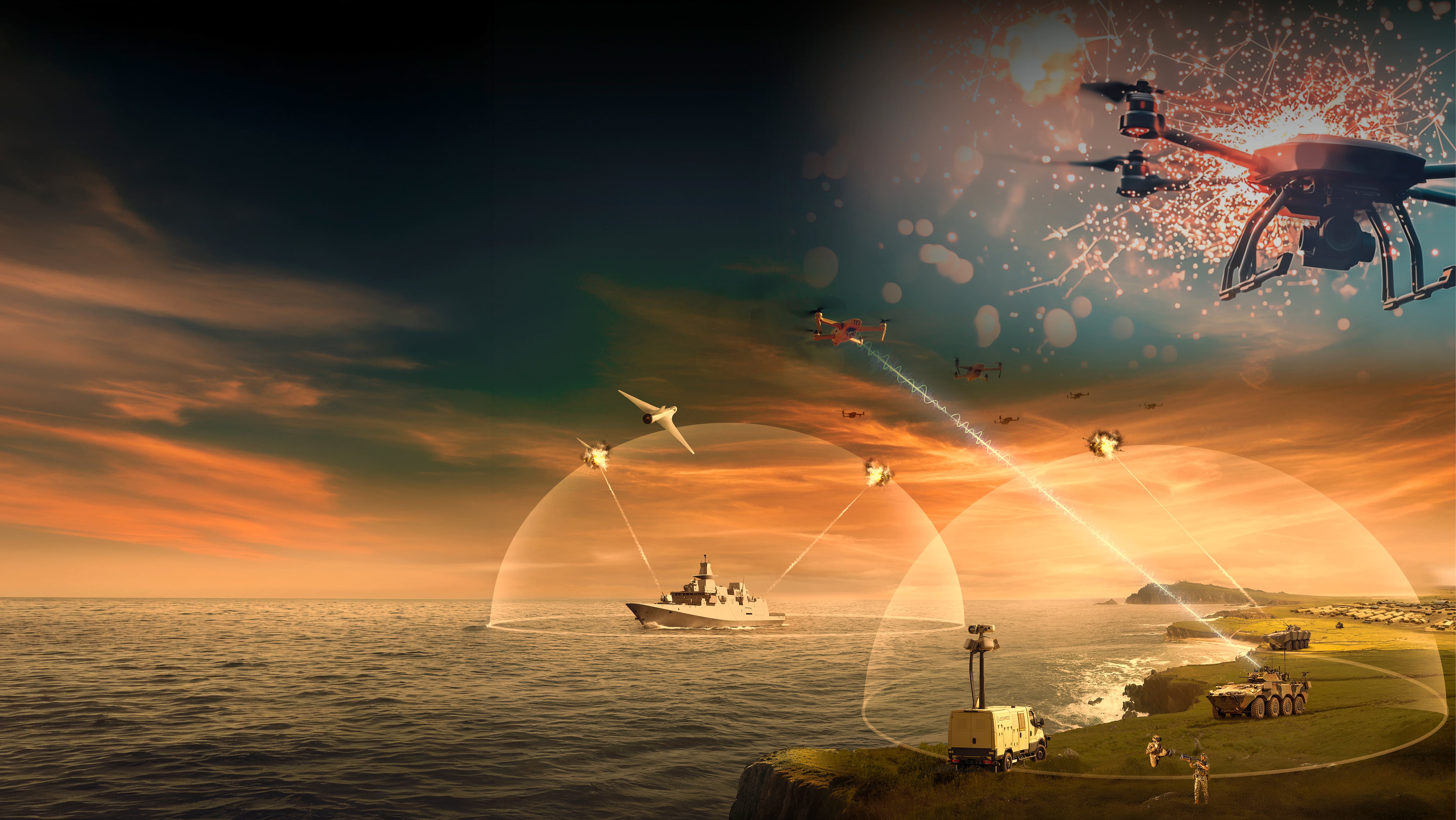

Counter-Uncrewed Air Systems (C-UAS) is amongst the top force protection considerations for today’s Armed Forces. There are few areas of military capability that have evolved as rapidly as Uncrewed Air Systems (UAS), with recent conflict in Europe and the Middle East showing how potent drone threats can be, and crucially how easily they can be scaled at a relatively small cost.
So how do Armed Forces rapidly respond to emerging drone threats as their adversary’s tactics, techniques and procedures change weekly or even daily?
The key is to establish a comprehensive, layered defence comprising different sensors and effectors. For this to be possible at the pace that modern operations demand, a C-UAS ecosystem such as Leonardo’s Falcon Shield must be based on open architecture – rapidly integrating the best and latest technologies to stay ahead of evolving threats, successfully detecting, tracking, identifying and defeating hostile drones.
This ‘integration advantage’ starts with Command and Control (C2). Leonardo’s C2 system is designed to generate capacity for operators – prioritising the most potent threats they are facing, advising on the most appropriate means of defeating a threat, and ultimately providing them with the most amount of decision-making time possible.
With a comprehensive, layered defence operators are shown threats at range, in order of priority, verified by multiple sensors – including electrooptical and infrared sensors such as Leonardo’s Nerio surveillance and threat acquisition system – which provides unrivalled high-resolution imagery at considerable distance.
Operators are then shown a list of available countermeasures and are advised on the most appropriate effector to select. This can include soft kill or non-kinetic effectors, including Radio Frequency jammers or cyber takeover systems, as well as hard kill or kinetic effectors such as interceptor drones or projectiles.
Layered protection is the best way of keeping personnel, critical assets and infrastructure safe. But our adversaries do not stand still – constantly changing and adapting their tactics, techniques and procedures to push every C-UAS capability to its limits. This is why having an integration advantage is so important.
Historically, the battle between countermeasures and counter-countermeasures is one that has taken place over months and years. It’s now days, or even hours. Operating a C-UAS ecosystem forged on open architecture means that integrating a new sensor or effector is also possible in days, or even hours. To be successful, this requires deep cooperation and trust between Armed Forces and industry.
The UK Ministry of Defence published the SAPIENT standard, which stands for ‘Sensing for Asset Protection with Integrated Electronic Networked Technology’. In simple terms, it is an open software standard which aims to reduce operator workload by using autonomy and Artificial Intelligence (AI). At its core, the architecture encourages and enables the ability to plug-and-play complementary modules, reducing the time it takes to integrate systems while creating an interconnected ecosystem that communicates in the same way.
NATO has also adopted the SAPIENT standard. At a recent Technical Interoperability Exercise (TIE), Falcon Shield’s C2 system came out on top after integrating with 46 new ‘sense, effect and C2 edge nodes’ – essentially integrating new complementary systems seamlessly into its C-UAS ecosystem. This rapid and seamless integration is exactly what will be required to defeat emerging drone threats on the battlefield, strengthened by the relationships between defence and industry.
The C-UAS team at Leonardo has been working in partnership with armed forces’ operators since 2012. These relationships are crucial – with feedback from operators who are detecting, tracking, identifying and defeating drones for real.
Ultimately, success depends on how quickly Armed Forces and industry adapt as threats evolves. Open architecture gives commanders that flexibility, integrating new sensors, effectors and decision-support tools at operational pace rather than on traditional procurement timelines. This is the integration advantage: a continually evolving ecosystem that brings together the best of industry, the experience of operators and the technologies needed to stay one step ahead.