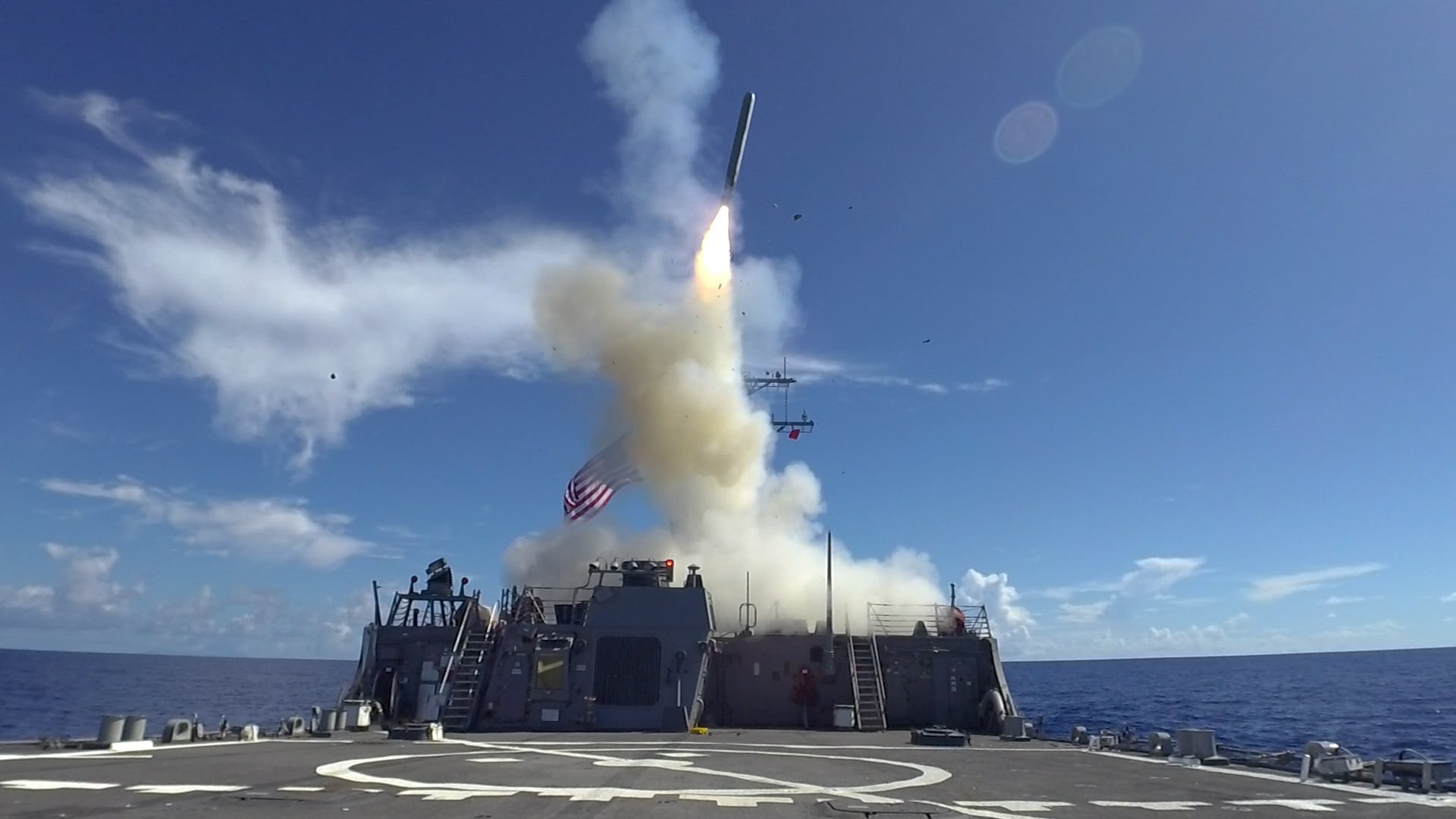
With the U.S. running low on expensive guided munitions, the Pentagon is pushing yet another project to develop cheap, long-range weapons that can be mass produced.
But this time, the Pentagon is in a hurry. The Iran war has exposed the problem of relying on costly long-range missiles such as the Tomahawk. To remedy that, DoD is putting out a call for long-range, autonomously guided Ground-Based Affordable Mass, or GBAM, weapons that cost less than $250,000 apiece.
The Pentagon also wants the GBAM munitions to be ready for demonstration within three months, and full-scale production within 18 months.
The goal of the GBAM initiative is to supplement expensive smart munitions with “affordable, scalable long-range effects, and “enable commanders to service a broader target set, preserve exquisite munitions for their intended purpose, and sustain operational tempo throughout a prolonged conflict.”
To facilitate that, the Defense Innovation Unit has created the GBAM Challenge. Contestants will pitch ideas in the form of a pitch deck or white paper, with a deadline of Aug. 5.
Winning teams will be invited to a Phase II flight demonstration at a government test site in early November, where they will give a 30-minute presentation — and get a $250,000 cash prize.
The top Phase II contenders may receive up to $5 million “to immediately deliver operational test quantities to units.” They may also be eligible for other funds, including Prototype Other Transaction agreements, follow-on production contracts and Small Business Innovation Research awards.
“In total, the government has budgeted up to $250 million to support prize execution and follow-on transition activities associated with this effort,” DIU pointed out.
However, grabbing that pot of gold will require much work. For starters, the timeline is tight. The Pentagon wants “mature, affordable, long-range precision strike systems that can be demonstrated within 60 to 90 days, certified, and scaled into production within 12 to 18 months.”
DIU doesn’t specify whether GBAM will be a missile or a drone, though it does say GBAM will be “aligned with the Direct Reporting Portfolio Manager for Unmanned Systems (DRPM-UxS) mandate to field low-cost autonomous capabilities at scale.”
Either way, the U.S. military wants a “favorable cost-per-effect at operationally relevant ranges while minimizing the logistical, training, and sustainment burden on employing units.” This means a ground-launched weapon with a range of at least 600 nautical miles, and a minimum payload of 35 pounds while ideally allowing for 100 pounds.
It should have automatic target recognition and autonomous terminal guidance, and be “ideally mission-proven” to function in jamming and GPS-denied environments. This includes “Alternative Position, Navigation, and Timing (PNT) or redundant navigation capabilities suitable for GPS/GNSS-denied operations in maritime and other ‘feature-poor’ environments.”
DIU is also looking for a weapon that doesn’t require any proprietary launch equipment, with “remote and low-signature launch methods strongly preferred.”
Companies should have an “existing production capacity or credible path to producing 100+ systems monthly.” And with a price tag of “cost-per-effect below $500,000 based on system reliability and mission success rate, with a sub-$250,000 all-up flyaway cost at scale.”
In addition to GBAM, the U.S. military is pursuing other strike weapons that don’t cost as much as traditional missiles, and can be mass produced as needed. They include the Family of Affordable Mass Missiles, or FAMM-BAR, program to launch cruise missiles from cargo planes, as well as the Low-Cost Containerized Missiles hypersonic weapons program.
Michael Peck is a correspondent for Defense News and a columnist for the Center for European Policy Analysis. He holds an M.A. in political science from Rutgers University. Find him at theuncommondefense.com. His email is mikedefense1@gmail.com.