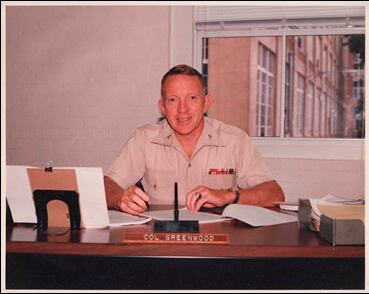
Retired Marine Col. John Greenwood, who spent 20 years as the editor of the Marine Corps Gazette and served as a former special assistant to the Office of the Secretary of the Navy, passed away on April 5. He was 87.
Greenwood, a veteran of the Korean and Vietnam Wars and Vietnam veteran, retired in 1980 after 30 years commissioned service. A prior enlisted Marine, he joined the Corps at the age of 17 shortly before the end of World War II, according to his obituary.
Before taking a position at coming to the Gazette following his retirement, Greenwood worked on a project to incorporate helicopters into amphibious doctrine, his obituary statesaccording to The Washington Post.
Greenwood had experience with amphibious units during his tours in Vietnam. HeDuring Vietnam, Greenwood served on the staff of both the 9th Marine Expeditionary Brigade and III Marine Amphibious Force. He later commanded the 1st Battalion, 27th Marines and then the 4th Combined Action Group, his obituary states.
In the mid-1970s, he commanded 2nd Marine Regiment at Camp Lejeune, North Carolina, and deployed as the commanding officer of two Marine amphibious units — one deployed to the Caribbean and the other one to the Mediterranean.
Greenwood also taught English, history and government at the U.S. Naval Academy, and served as the aide to the Commanding General Fleet Marine Force Pacific, Lt. Gen. ieutenant General Victor H. "Brute" Krulak, the commanding general of Fleet Marine Force Pacific, according to the obituary.
As a special military assistant to Navy Secretary John W. Warner, Jr., Greenwood he avidly championed for the Marine Corps flag to be incorporated into the United States Naval Academy color guard.
Greenwood was appointed as the editor of the Marine Corps Gazette upon retiring in 1980. He While at the Gazette, Greenwood worked to mentor young writers and, like his devotion to the Marine Corps, consistently discussed ways to make the service better through steadfast leadership and strength in military capabilities.
"While Colonel Greenwood proved to be a tough taskmaster [as my editor], I must admit that my knowledge base increased tenfold on these and other individuals who served in the Marine Corps during the interwar era under his tutelage," wroteites Leo Daugherty III in his book, "Pioneers of Amphibious Warfare, 1898-1945."
"As Colonel Greenwood stressed during one of our many meetings, the history of amphibious warfare was more than just the story of general officers or popular heroes," Daugherty wrote. "Instead, it was the story of the efforts and hard work of those true pioneers, the colonels, lieutenant colonels, majors and captains who labored tirelessly to forge the Corps' amphibious warfare doctrine." Daugherty says
Through the journal, Greenwood established the MajGen Harold W. Chase Essay Contest, giving active-duty and Reserve Marines the ability to "challenge conventional wisdom by proposing change to a current Marine Corps directive, policy, custom, or practice," according to its website. He also chaired the selection committee for the General Wallace M. Greene, Jr. Award for distinguished non-fiction books dealing with Marines and the Marine Corps' lifestyle.
Born in 1927 in Warren, Ohio, Greenwood enlisted in the Marine Corps at the age of 17 shortly before the end of World War II. In 1946, he received a fleet appointment to the U.S. Naval Academy in 1946. He graduated in 1950.
Greenwood is survived by his wife, Margaret Anne Barnes Greenwood, their five sons and 17 grandchildren.
Services will be held on April 15 at Murphy Funeral Home in Arlington, Virginia. The following day, Greenwood the following day will be buried at Quantico National Cemetery.