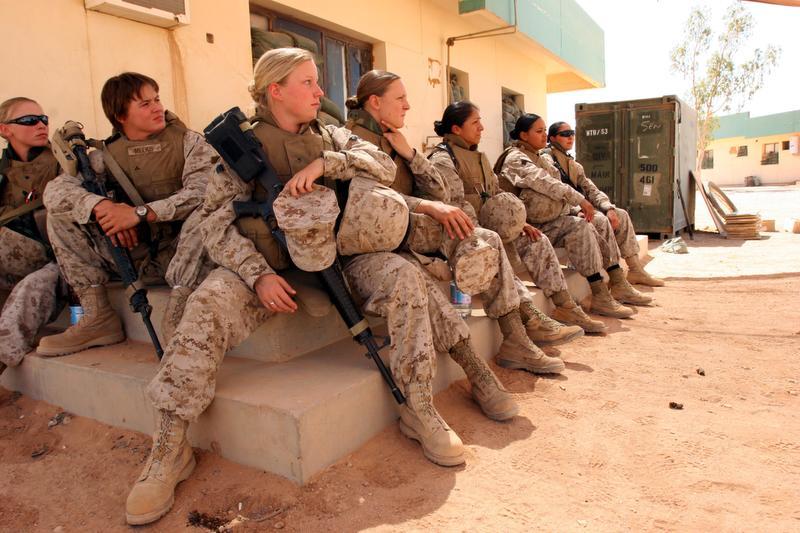
The Marine Corps is about to launch one of its most comprehensive experiments to test the mettle of women in combat, but an active-duty female officer has a message for the Corps: Don’t bother.
In a 2,800-word treatise that earned first place in the Marine Corps Gazette’s Maj. Gen. Harold W. Chase Essay Contest, Capt. Lauren Serrano argues that women don’t belong anywhere in the U.S. infantry, an assertion that immediately sparked a firestorm of controversy. The essay comes as the Marine Corps prepares to field its Ground Combat Element Integrated Task Force, which will evaluate the performance of male and female Marine volunteers in a unit modeled after a battalion landing team. The Corps must comply with a Defense Department directive to open all Marine combat jobs to women by early 2016 or seek specific exceptions based on research.
Serrano’s premise is reminiscent of a 2012 Gazette essay by Capt. Katie Petronio, a Marine engineer who argued that women were not built to handle the physical strain of extended combat operations, citing training data and medical complications that resulted from her own deployment to Iraq.
But there the similarity between the two essays ends. Serrano, an intelligence officer enrolled at National Intelligence University, argues that it doesn’t matter whether women can physically endure combat hardships or make it through a grueling infantry training program. They don’t belong, she writes, because they’re a threat to mission readiness and unit cohesion in the all-male infantry ranks.
“Female Marines who want to stir the pot by joining the infantry ranks are more interested in their careers than the needs of the Corps — they are selfish,” Serrano wrote. “The time, energy, and conflict associated with setting women up for success in infantry billets will not make the Marine Corps more combat effective.”
Serrano cited then-2nd Lt. Sage Santangelo,who wrote a Washington Post opinion editorial about why she believed the Marine Corps should better prepare women to pass the Infantry Officer Course, which she attempted unsuccessfully as part of Marine Corps research.
“How will that [gender integration] contribute to a better fighting force, the needs of the Marine Corps, and the success of young enlisted Marines?” Serrano wrote.
Serrano declined an interview through a Marine public affairs officer, and Santangelo provided only a brief statement, “everyone is entitled to their own personal opinions.”
Others have been less reticent to challenge Serrano.
In a public response on the Marine Corps Gazette’s blog, Marine Maj. Edward Carpenter, an aviation logistician, disputes the need to preserve the unrefined and cult-like infantry brotherhood “without the distraction of women or political correctness,” as Serrano put it.
Instead of arguing for a better way of doing business in accordance with the Gazette contest’s rules, Carpenter wrote, Serrano argued for business as usual.
“My master gunnery sergeant and I have been pondering what we could do to increase unit cohesion among our Marines,” Carpenter, Aviation Supply Officer for Marine Aviation Logistics Squadron 31 in Beaufort, South Carolina, wrote, with heavy sarcasm. “I just need to transfer all my stellar female [Marines] to other commands and give my remaining male Marines the go-ahead to engage in behavior that’s clearly outside the bounds of common courtesy, good order and discipline.”
Anu Bhagwati, executive director of the Service Women’s Action Network and a former Marine captain, called the essay “archaic, misinformed, and disgraceful.”
Serrano showed as much sexism toward men as women, she said, by depicting male Marines as driven by their sex drives and unable to distinguish between right and wrong while calling female troops selfish and career-focused.
“It’s not relevant in the year 2014,” Bhagwati said. “It’s just another sign of the Marine Corps encouraging incredibly backwards sentiments.”
At the military blog Task and Purpose, retired Lt. Col. Matthew Morgan, a former public affairs officer, described the essay as “sororicide,” saying it showed poor leadership, not bold thinking. Morgan said Serrano’s assertion that female Marines have just as much room for advancement in non-combat positions was not borne out in a Corps whose leadership ranks are dominated by infantry officers.
But Serrano’s most disappointing argument, he said, was that keeping women out of combat would protect them from sexual assault.
A self-described victim of sexual assault, Serrano calls prosecution of these offenses disruptive and costly to the Corps.
“As the pinnacle fighting elements of the Marine Corps, it is in the best interest of the infantry units to mitigate the opportunities for sexual assault/harassment,” she wrote. “If women are part of infantry units, it will be a matter of when, not if, more sexual assault cases will happen.”
Morgan wrote that this argument shifted blame from the perpetrators of sexual assault to the victims.
The editor of the Marine Corps Gazette, retired Col. John Keenan, said he felt Serrano’s essay achieved the contest goals of being bold and daring . The essay, he said, was selected from 41 submissions by the Gazette’s editorial advisory panel. That panel includes four retired and six active-duty officers, three active senior enlisted Marines and one Marine Corps civilian, but no women. Though Serrano describes herself as a female officer in the article, Keenan said the selection process is blind and anyone could have written it.
“What she’s giving voice to is a camp that’s putting the institution over the individual,” Keenan said. “That’s a deep-seated Marine ethos: You can’t denigrate Marine combat capability.”
Keenan said the magazine, initially formed by the Marine Corps in 1916, was designed to serve as a platform for debate, and the essay accomplished that goal.
A Marine official said Marine Corps headquarters had been aware of the essay for months, as with all Gazette contest winners, but had not vetted it or altered its content.