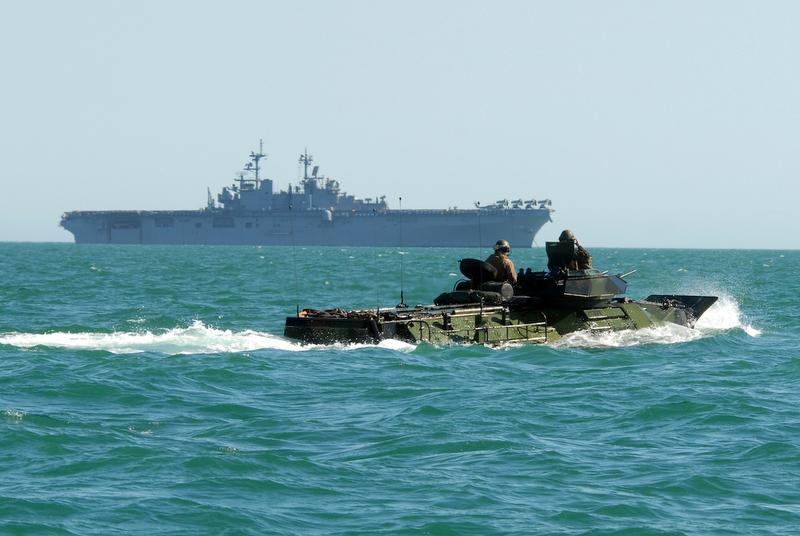
The blue-green team will flex its amphibious muscles once again in Exercise Bold Alligator 2014, planned for late October-early November.
The exercise, held every other year, will throw multiple crisis-response scenarios at participants, which include forces from 19 nations and 19 U.S. Navy and coalition ships. Roughly 8,000 U.S. and international Marines will participate, led by the 24th Marine Expeditionary Unit out of Camp Lejeune, North Carolina. This force will also include Dutch, British, Canadian and Brazilian marines.
The previous exercise centered on large-scale amphibious landings against strong opposition. This year, crisis response and humanitarian assistance is the name of the game. But don’t plan on phoning this one in — organizers have plenty of hostile opposition planned. As such, the exercise will include integrated fire support for forces as they conduct forcible entries into complex and uncertain environments with coalition partners. In fact, a Dutch one-star will lead one of three task groups.
“Bold Alligator 2014 provides an opportunity for the training and further development of Marine and Navy amphibious-based units and their crisis response capabilities,” Lt. Gen. Robert Neller, commander, Marine Corps Forces Command MARFORCOM, said in a release. “It also provides a venue to showcase the Blue-Green team as the nation’s ‘insurance policy’ for crisis response and contingency operations.”
Bold Alligator will host 22 experiments that range from the command to tactical levels, said Michael “Mort” White, who designs and organizes the training event for Carrier Strike Group 4. The response will begin with a relatively new concept, the Forward Integrated Command Element. Comprising flag and general officers from Expeditionary Strike Group 2 and 2nd Marine Expeditionary Brigade and a cadre of 15 to 20 officers, the FICE will land on the amphibious assault ship Iwo Jima, plant the flag and take charge of the mission.
A joint high-speed vessel will be put to the test as events unfold. The 2nd MEB will use USNS Choctaw County, crewed by civilian mariners with Military Sealift Command, to transfer fuel trucks ashore. The catamaran is designed for rapid intra-theater transport of troops and equipment.
“What defines the littorals is being changed because of capabilities we have now, like the V-22 and some of our communications and command-and-control capabilities,” White said. “So Marines will find themselves going a little deeper than the shoreline on some of these missions.”
Special operations forces will then use JHSV as a launch platform, Navy Expeditionary Combat Command will use it as an unmanned undersea vehicle support platform and JHSV will support Dutch riverine operations.
The Navy also will use the exercise to evaluate USNS Medgar Evers, a dry cargo/ammunition ship, as an alternate command, control, operational and logistics platform. New radios also will be tested at the tactical level.
Involved in the exercise:
■ II Marine Expeditionary Force
■ 2nd Marine Expeditionary Brigade
■ 24th Marine Expeditionary Unit
■ Marine Air Group 29