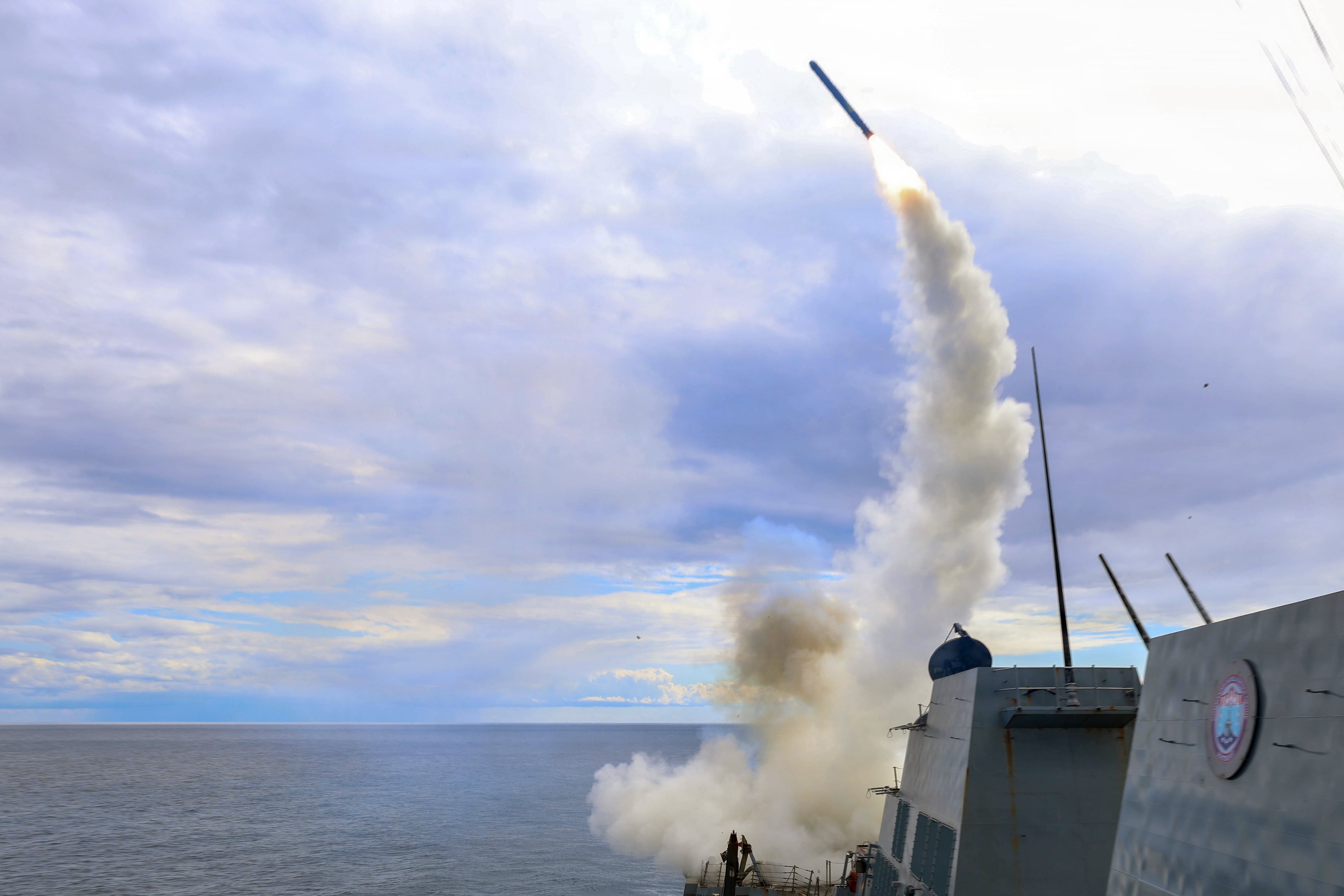
The United States will need at least three years to restore an array of critical weapons systems to prewar levels following its 38-day bombing campaign against Iran, according to the Center for Strategic International Studies.
The new analysis, released on Wednesday, warned that depleted inventories have “created a window of vulnerability for a potential Western Pacific conflict. The time needed to rebuild those inventories has thus become a major concern.”
However, the authors acknowledged that the U.S. “has enough munitions for any plausible scenario in the Iran war.”
U.S. Central Command said more than 12,000 targets were hit during Operation Epic Fury, which CSIS found significantly drew down America’s stockpiles of Tomahawk Land Attack Missiles (TLAM), as well as two vital interceptors: the Terminal High Altitude Area Defense (THAAD) and the Patriot.
The think tank, a bipartisan policy research organization, estimates that more than 1,000 Tomahawk missiles were launched, far exceeding the average annual procurement of 86 over the past decade – and that replenishment could take until 2030 or 2031. It also determined that up to 290 THAAD interceptors were used, with those reserves returning to prior levels only by mid-to-late 2029.
The Pentagon has not publicly disclosed the scale of munitions expended before a ceasefire between Washington and Tehran took effect April 7, citing operational security. But Jules Hurst III, the Defense Department’s acting comptroller, told lawmakers earlier this month that the conflict had cost roughly $29 billion, with additional expenditures still expected.
The authors of the report argue that today’s challenge “isn’t money; it’s time.”
“It takes time to expand production capacity and to build these complex systems. Thus, there will be a window of vulnerability for several years until inventories return to their previous levels and another several years before they get to the levels that war planners desire,” they wrote.
“China is deeply aware that it has no recent combat experience and that it performed poorly in its last war—against Vietnam in 1979," the analysis continued. “That difference in experience may preserve deterrence until munitions inventories are restored.”
In a statement to Military Times, White House Deputy Press Secretary Anna Kelly asserted that the U.S. military “has more than enough munitions, ammo, and stockpiles to serve all of President Trump’s strategic goals and beyond.”
“Even still, the president has urged our defense contractors to constantly produce more made-in-America weapons, which are the best in the world. Democrats destroyed our military, but President Trump rebuilt it. Think tank armchair quarterbacks are not read into sensitive information and have no idea what they’re talking about,” she added.
Trump recently held a meeting with executives from major defense contractors — including BAE Systems, Boeing, Honeywell Aerospace, L3Harris Missile Solutions, Lockheed Martin, Northrop Grumman and Raytheon — to discuss expanding production capacity. The president subsequently announced that the CEOs “agreed to quadruple Production of the ‘Exquisite Class’ Weaponry in that we want to reach, as rapidly as possible, the highest levels of quantity.”
Defense Secretary Pete Hegseth, who has conceded that replenishing the Pentagon’s arsenal will take “months and years,” depending on the system in question, emphasized on Wednesday that the process is already underway.
“Defense manufacturers are investing in new plants, and new manufacturing, new production lines, so that we’re getting weapons faster than ever,” Hegseth said during a cabinet meeting at the White House.
Tanya Noury is a reporter for Military Times and Defense News, with coverage focusing on the White House and Pentagon.


