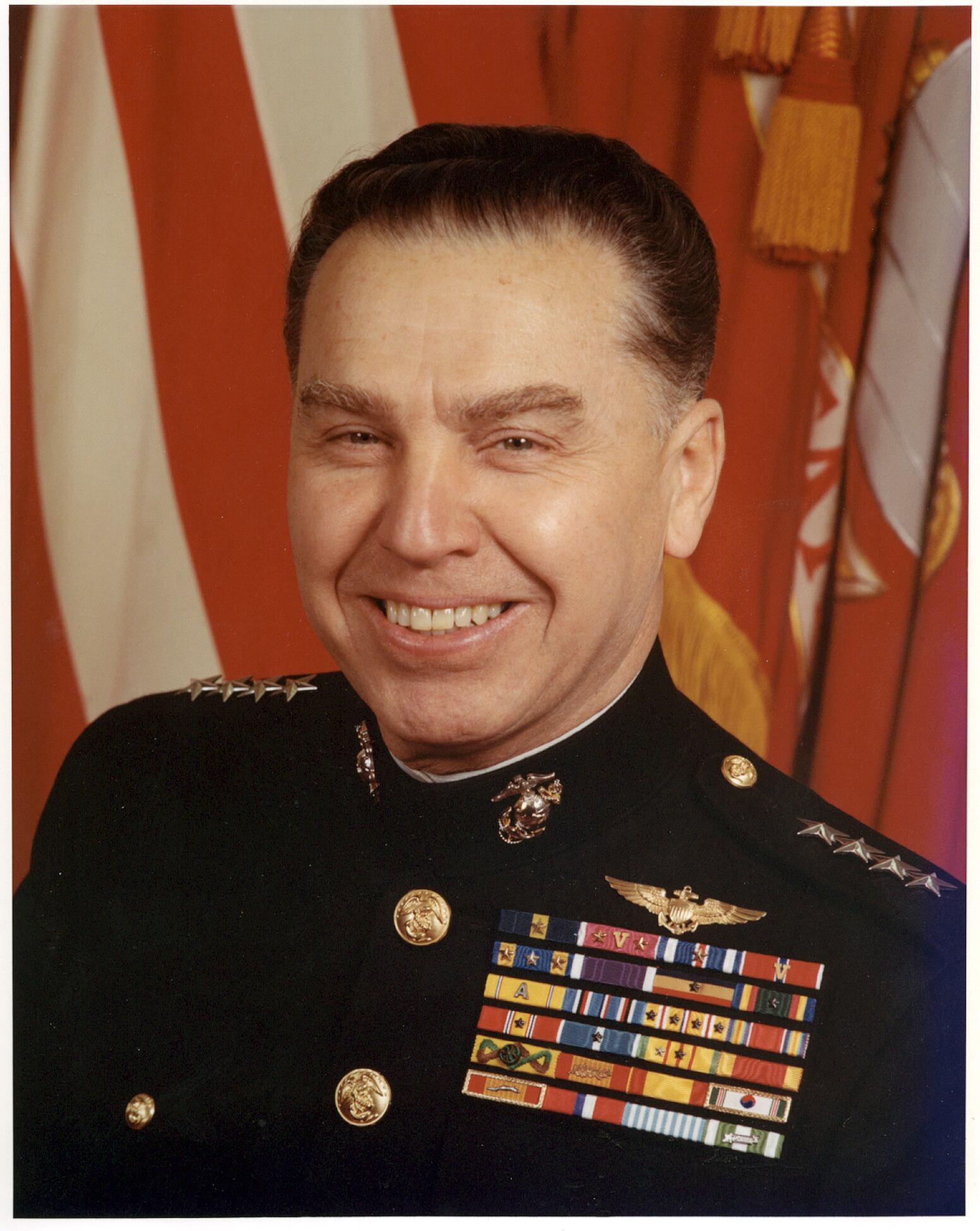
Gen. Earl Edward Anderson, the first active-duty Marine Corps aviator to become a four-star general, will be laid to rest Thursday at Arlington National Cemetery.
Anderson, who served as assistant commandant from March 31, 1972, to June 30, 1975, died Nov. 12.
"He was so inspiring to our people," said J. William Middendorf, who served as Navy secretary from 1974 to 1977. "He's a big loss to the Corps."
Middendorf described Anderson as "a really great Marine" who "did a fabulous job" during Middendorf's tenure as Navy secretary.
"Gen. Anderson was a proven combat leader and skilled aviator in three wars and for over 35 years," Assistant Commandant Gen. John Paxton Jr. wrote in an email to Marine Corps Times. "He was the ACMC (72-75) when I was commissioned as a 2dLt and one of those 'three war giants' we all looked up to and listened to."
After being commissioned as a second lieutenant in June 1940, Anderson served aboard the carrier Yorktown during World War II's first major battles in the Pacific, including Coral Sea and Midway. He was rescued from the Yorktown when it capsized and sank June 7, 1942.
"He earned two Distinguished Flying Crosses for aviation courage and six Air Medals during these campaigns," Paxton told Marine Corps Times. "He also earned a Purple Heart and Combat Action Ribbon for wounds received aboard USS Yorktown (CV-5) before she was sunk during Midway."
In the spring of 1953, he was dispatched to Korea, where he served first as a squadron commander and then as the assistant chief of staff of personnel for the 1st Marine Aircraft Wing.
During the Vietnam War, Anderson flew more than 40 combat missions against the Viet Cong and later as chief of staff for III Marine Amphibious Force, Republic of Vietnam. He received his fourth star when he became assistant commandant in 1972, becoming the youngest active-duty Marine to attain that rank, according to MARADMIN 008/16.
As assistant commandant, Anderson played a major role in defending the CH-53E and obtaining artillery that was helicopter transportable and other modernization programs, said Maj. Anton Semelroth, a spokesman for Marine Corps Combat Development Command.
"Most importantly in this time (1972-1975) Gen Anderson was directly involved with the Commandant, Gen. Robert E. Cushman with working personnel issues, like how to enlist quality Marine Corps recruits using the experience he gained while serving as Head of Personnel for HQMC in 1969," Semelroth wrote in an email to Marine Corps Times.
Marine Corps Commandant Gen. Robert Neller has authorized flags be flown at half staff through sunset on Thursday in honor of Anderson's service.
"We are proud of and grateful for his service, his leadership and his valor in combat," Paxton said. "His 35-year career as a Marine and as an aviator was characterized by major sea changes in our national security and defense, our global standing and in the Marine Corps' evolution as a battle hardened force committed to be 'most ready when our nation is least ready.'"
Paxton will be attend Thursday's memorial service and interment at Arlington along with Lt. Gen. Jon Davis, deputy commandant for aviation, and many other current and former Marines.
"Gen. Anderson's impact on that legacy and that state of readiness can be seen in his contributions in the air, on the ground, and at headquarters," Paxton said. "Our Corps is proud of his service and leadership and we extend our condolences to his wife of 66 years, Jane, and his three children and extended family."