The Navy is developing an automated detection system designed to alert crews when someone goes overboard, a capability that could help close a gap in shipboard safety. But detecting a person in the water is only the first challenge in a rescue, and getting the technology from an engineering test to operational warships will require additional funding, testing and a clearer path to the fleet.
Navy engineers in California are developing a technology intended to address part of that problem. Developed by the Naval Surface Warfare Center, Port Hueneme Division, and led by Eric King, a former petty officer first class, The Man Overboard Detection System uses thermal cameras and video analytics to identify potential overboard events and alert a ship’s crew.
“Being a former sailor myself, that was always something that was in the back of my mind: ‘Wow, if I fall overboard in the middle of [the] night, hopefully someone sees me,’” King told Task and Purpose. “There’s nothing that will instantly detect if someone falls from the ship. I think the system closes that gap and provides peace of mind, and not just for the sailors, but for the fleet.”
The cost of a delayed alert
On a vessel carrying hundreds or thousands of people, maintaining a constant watch over every stretch of railing is a challenge no crew can realistically sustain. If someone enters the water unnoticed, the crew may not realize an emergency is underway until valuable time has passed.
The difference between an immediate alert and a delayed discovery can be enormous, said Mario Vittone, a maritime safety expert and former Coast Guard rescue swimmer.
“The significance between ‘I know exactly where you fell off’ and ‘I sort of know it was in the last few minutes’ can be staggering,” Vittone told Military Times.
“If the vessel you are on loses sight of you and they have to do a search or call in another asset such as the USCG, another military helicopter, etc., then you have slipped into the more likely to die than live category,” he said.
An immediate alert can preserve two of the most useful pieces of information in a rescue: when the person entered the water and where it occurred.
“Knowing that they went in is number one,” Vittone said. “Exactly where they went in matters a great deal.”
The goal, he said, should be an alert as fast and accurate as if a crew member had witnessed the incident and immediately reported it to the bridge. Once a ship loses sight of someone, wind and currents can move the person away from the last known position, while waves and foam can obscure them from view.
“The real value of these systems is removing the human limitations of manpower and fatigue,” he said.
An automated system could monitor a ship’s perimeter continuously without depending on someone being in the right place at the right time. But it must do more than register movement. It has to distinguish a person entering the water from the many other objects and conditions that can appear in a camera’s field of view.
For the Navy’s development team, the advantage is the system’s ability to monitor continuously, including when darkness or distraction could cause a human lookout to miss an incident.
“A human lookout can easily miss an incident in the dark or due to distraction, whereas the man overboard camera system provides continuous monitoring,” Mr. David Dozal, a system engineer at Naval Surface Warfare Center Port Hueneme Division, told Military Times.
Dozal said the system is specifically engineered to detect thermal signatures and performs as well as or better than a human observer during the day, with a greater advantage at night or in low-visibility conditions. Once it detects an overboard event, he said, the system is designed to immediately alert the bridge, removing human delay.
Recognizing a person in the water
Waves, sea spray, birds, floating debris and changing light can all complicate detection. A person may be visible one moment and obscured the next.
“Is that a body or a bag of trash? Is that a body or sea birds swooping by the hull?” Vittone asked, describing the kinds of distinctions an automated system must make.
He believes successful systems will likely combine artificial intelligence with multiple types of sensor data, including visual, thermal and potentially or Light Detection and Ranging, or LiDAR, imaging. The challenge is developing algorithms accurate enough to recognize a person without repeatedly mistaking other objects for an emergency.
A 2024 review published in the Journal of Marine Science and Engineering examined 51 research papers on automated detection and search and tracking in maritime person-overboard scenarios.
The review illustrates the amount and variety of data needed to train and evaluate detection systems, with a person’s position and condition significantly affecting how easily a detection system can identify them. The system must recognize more than an upright person clearly visible on the surface.
False alarms also remain a fundamental obstacle. A system that repeatedly mistakes debris or seabirds for a person could undermine crew confidence in its alerts. A system that fails to recognize someone in darkness, rough water or poor visibility could create a different risk: the appearance of protection without dependable performance.
From an engineering test to an operational warship
The Navy’s initial demonstration took place Aug. 14 aboard the Navy’s Self Defense Test Ship, the ex-Paul F. Foster, a decommissioned destroyer now used as a test platform.
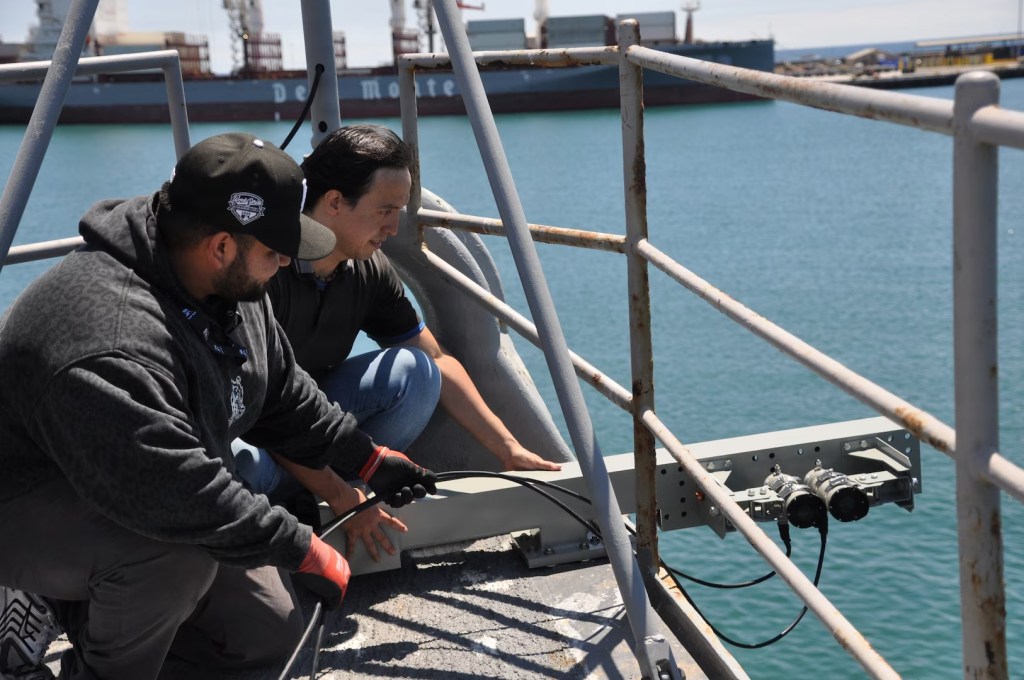
Engineers temporarily installed four thermal cameras in two specially fabricated pedestals positioned approximately 200 feet apart along the ship’s starboard side. Each pedestal held two cameras: one monitoring the area immediately alongside the hull and another providing medium- and longer-range coverage. The overlapping views were designed to reduce blind spots and help the software identify an object crossing the ship’s perimeter.
To simulate someone falling overboard, engineers used a 6-foot, 35-pound vinyl rescue dummy named OSCAR, a reference to the international signal flag for a man-overboard emergency.
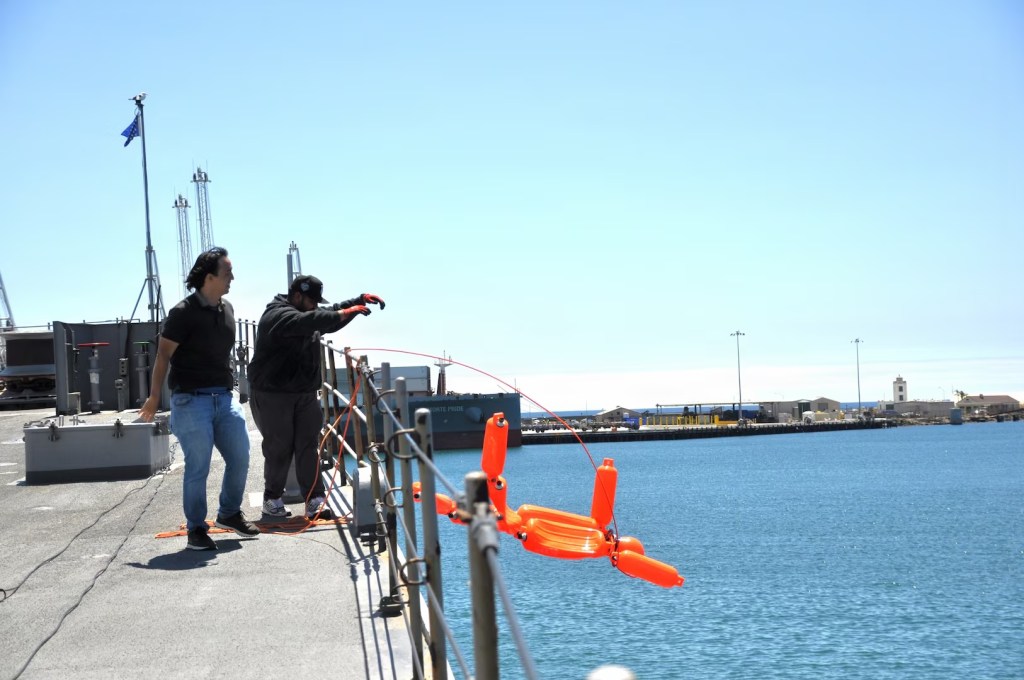
Mechatronics engineer Daniel Lopez and systems engineer David Dozal repeatedly dropped the dummy over the side of the vessel, while other members of the team monitored the camera footage from inside.
The Navy described the demonstration as successful in showing that the cameras and software could detect the simulated overboard event. But the test did not include the bridge alarm that would ultimately notify the ship’s watchstanders. The equipment also covered only part of the vessel, rather than the full perimeter required for an operational installation.
Those limitations leave important questions about how the system would perform aboard a working warship, withstand harsh maritime conditions and provide information quickly enough to support a rescue.
The project initially received funding through the Naval Innovative Science and Engineering program, which supports research and development at Navy warfare centers. That funding has ended, and the development team is looking for another source of money to continue testing.
The team’s next objective is to test the technology aboard an operational guided-missile destroyer in San Diego. But a test aboard an active destroyer would be considerably more demanding than the August demonstration. A permanent installation would require camera pedestals to be secured to the ship’s deck, cables to be routed safely and the equipment integrated with the systems responsible for notifying the crew. Developers would also need to determine the cost of a complete installation and how much maintenance it would require.
Detection is only the beginning of a rescue
An automated alert could give the crew an earlier starting point in the event of a man overboard, but it would not guarantee that the person could be found or recovered.
Sea conditions, water temperature, the ship’s speed and the availability of rescue assets will continue to influence the outcome. The detection system must be able to provide reliable location information and maintain a useful track, even if the person becomes temporarily obscured.
The Navy has shown that its cameras and software can detect a simulated person going overboard in a controlled demonstration. Whether the service can turn that proof of concept into a dependable safety capability will depend on further funding, testing under real operating conditions and a decision about whether the system can be installed and maintained across the fleet.