The Marine Corps is engaged in a multi-year pilot program to determine whether the standardized test the military has used since 1968 might be swapped out for a more holistic way to capture troops’ experiences and abilities.
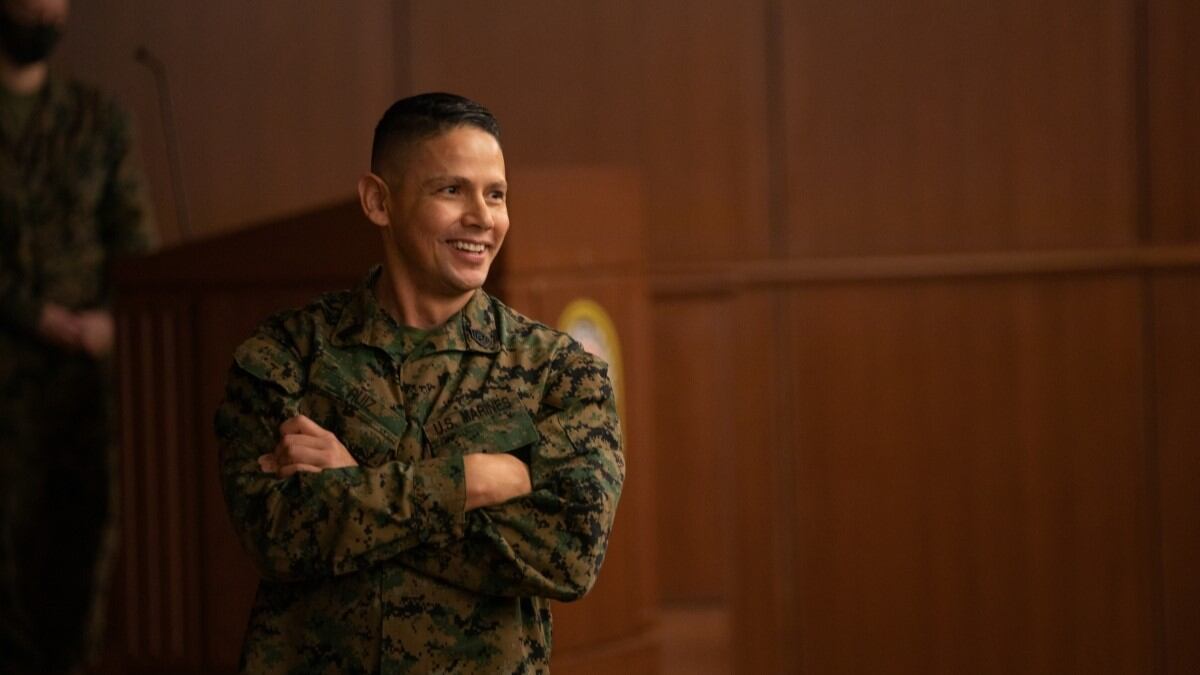
In a senior enlisted leaders forum hosted last week by Military Officers Association of America, Sergeant Major of the Marine Corps Carlos Ruiz discussed the pilot and the Corps’ hopes of getting away from the Armed Services Vocational Aptitude Battery, which is administered prior to enlistment and determines what jobs troops are eligible for.
“Is the ASVAB … score the only indicator of success? We say it’s not,” Ruiz said.
He added that the Marine Corps had “almost seven years’ worth of data” assessing the comparative value of another test, the Tailored Adaptive Personality Assessment System, or TAPAS. When young people come in to take the ASVAB at a military entrance processing station, he said, they can stay seated and take the TAPAS.
“What are the traits, the characteristics of a young person that make them more likely to succeed in the Marine Corps?” Ruiz said, adding these can include performance in high school, sports experience, family background, place of origin.
These data points, he said, can potentially tell the Marine Corps not only how well a prospect will do in the Marine Corps, but also the best time to ship them out and even who they might bring into the service from their own community.
“We can probably, pretty much invest in you a lot more, because we likely know you,” Ruiz said.
Ruiz added that the assessment of the personality test will be longitudinal, tracking outcomes over the scope of a career.
“We’re going to pilot that for a little while, follow these Marines through their whole career, and see, how did someone like me who barely passed the ASVAB test end up here?” he said. “Is it the institution … is it because I have certain characteristics? I have no idea, right? I just know that the ASVAB test isn’t the only indicator of success, and we should explore that a little more.”
According to a 2023 Air Force Research Laboratory report, the Air Force, Army and Marine Corps are all currently offering TAPAS at MEPS alongside the ASVAB. The Marine Corps, according to the report, first asked in 2014 for a version of TAPAS to be administered to their applicants for research purposes, and got the test up and running at MEPS in late 2015. By 2019, the report states, some 1.2 million applicants from the three services had taken the test.
That report concludes that the data appears to support tapping into the pool of military applicants who might score poorly on the portion of the ASVAB that qualifies one to serve in the military, but do well on TAPAS.
“Research has also shown that placing individuals into a [military occupational specialty] consistent with their personalities can yield improved performance,” it adds.
The military has for years pursued noncognitive tests and success predictors as a way to determine an individual’s potential to thrive in military environments, from making it past entry-level training to staying in for subsequent enlistments.
A 2017 Naval Post-Graduate School study zeroed in on the now-closed Marine Corps Scout Sniper Course, noting that some 55% of trainees dropped out before graduation, at significant expense to the service. The study used “grit” screening and personality analysis to predict Marines’ ability to make it through the end of training, finding statistically significant evidence that it did.
“We recommend the Marine Corps develop and standardize noncognitive measures to facilitate job matching, such as in the preselection of the most suitable scout sniper candidates,” that study concluded.
It’s not clear, though, that a personality-based test could ever replace a standardized achievement test entirely, and the Marine Corps has yet to release any data on what they’ve learned so far.